
Author: Kay Czepli-George
July 2026
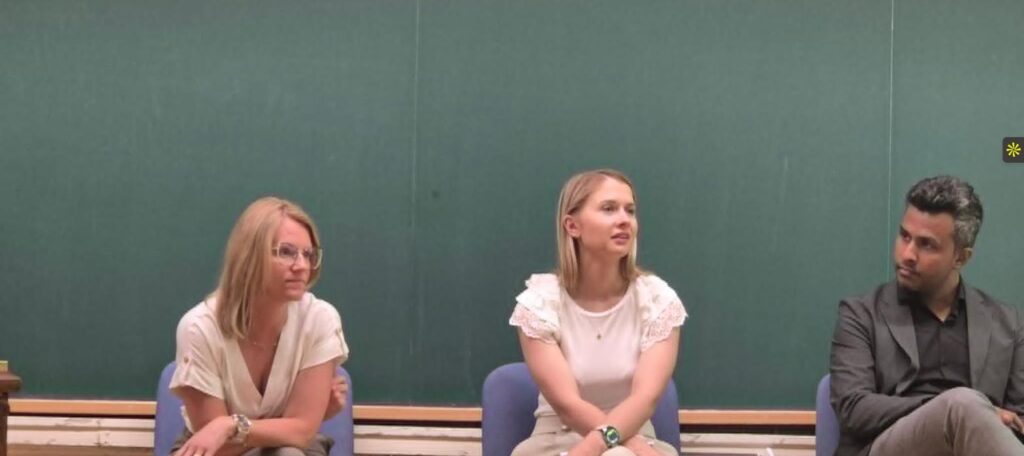
In June this year, Gaja Niemkiewicz from our Foundation and I had the privilege of attending the international academic conference “A Focus on Pedagogy: Contemporary Teaching in a Time of Change” in Madrid. It was one of those events that stays with you not only because of the research presented, but also because of the conversations that followed – the questions asked after the presentations, the reflections shared in between sessions, and the sense that many of us were trying to name the same thing from different places in education.
Two presentations stayed with me in particular: Dr Magdalena Boczkowska’s “Teacher Resilience: The Role of Risk and Protective Factors” and Annette Sweeney’s “Shaping Creative and Resilient Learners Using Mindful Pedagogy: Pedagogical Insights from Culinary Art.” Although they approached education from different angles, both spoke directly to something we see every day in our foundation’s work with teachers: teacher wellbeing is not a luxury, a bonus, or something to squeeze in once the “real work” is done. It is the ground on which good teaching stands.
As a psychologist, therapist, educator and mentor for teachers, I often hear teachers say: “I know what I should do, but I just don’t have the energy to do it.” That sentence matters. It tells us that wellbeing is not simply about information. Most teachers already know that sleep, boundaries, movement, hobbies, supportive relationships and rest are good for them. The problem is that school life often leaves too little space for these protective factors to actually exist.
This is why Boczkowska’s work is so important. Her research moves us away from the idea that resilience is an individual superpower that some teachers magically possess. Instead, teacher resilience is understood as a dynamic interaction between personal, social and physical resources that help teachers respond to risk factors in the school context by maximising protective factors. In her 2023 study of 752 teachers in Poland, Boczkowska found that teachers’ resilience differed depending on sociodemographic and professional factors, including age, place of residence, marital status, workplace, length of service and professional promotion level. Teachers scored highest in the area of family cohesion, but lowest in social competence and peer support (Boczkowska, 2023). For me, this finding says something very practical and very human: many teachers are surviving because of support outside school, while support inside professional communities may still be too weak.
During the Madrid conference, Boczkowska also presented findings from her latest study, conducted with over 340 teachers from Polish schools. One of the key findings was especially powerful: hobbies and the promotion of healthy work-life integration – including teachers’ autonomy to develop their own passions – support the development of teacher resilience. This may sound simple, but it is not superficial. It shifts the conversation from “teachers should manage their stress better” to “schools should create conditions in which teachers can remain whole people”.
This distinction matters. A hobby will not repair a toxic workplace. Let’s not insult teachers with the idea that knitting, gardening or yoga can fix chronic overload, poor leadership or unsafe working cultures. However, personal interests can still be powerful protective factors. They reconnect teachers with parts of themselves that are not only responsible, functional and endlessly available to others.
A teacher who sings in a choir, runs, paints, gardens, plays board games, bakes, dances, learns a language or walks in nature is not “wasting time”. They are protecting identity. They are telling the nervous system: “I exist beyond my role.” That is psychologically important. When work becomes all-consuming, the self becomes narrow. Hobbies widen it again.
This is where schools and leaders have real influence. Promoting healthy work-life integration is not about adding a wellbeing poster in the staffroom next to the broken kettle. It is about protecting time, respecting boundaries, avoiding unnecessary after-hours communication, valuing teachers’ lives outside school, and creating a culture where having passions beyond work is seen as a strength, not a lack of commitment.
Boczkowska’s later comparative work with Daniilidou and Platsidou also adds an important layer. In a 2024 study of 1,622 teachers from Greece and Poland, the authors examined protective factors of teacher resilience across both groups. The study found broadly similar patterns, but Greek teachers scored higher in social competence and peer support and also reported higher overall resilience than Polish teachers (Boczkowska et al., 2024). This is not a small detail. It suggests that relationships, collegiality and professional connectedness may be central to teachers’ ability to remain psychologically well.
This also helps us use the word “resilience” more responsibly. Too often, teachers are told to “be resilient” when what is really meant is: “Please tolerate more and complain less.” That is not resilience. That is endurance with a motivational quote stuck on top. Real resilience is not about becoming immune to stress. It is about having enough internal and external support to recover, adapt, ask for help, set boundaries and keep a sense of meaning.
Annette Sweeney’s work on mindful pedagogy connects beautifully with this. In her 2025 systematic review with Jolanta Burke and Trudy Meehan, the authors examined the impact of mindful pedagogy on creativity in higher education. The review included five studies selected from 101 initially identified records. The key finding was that mindful pedagogy can support creativity, creative confidence and wellbeing, especially when mindfulness is embedded informally into learning rather than treated only as a separate meditation practice (Sweeney et al., 2025).
Her 2026 case study, “Stepping into Wellbeing”, explored informal mindful pedagogy in a culinary education context. The study drew on interviews with 11 graduates and 7 students, as well as module artefacts, co-creation workshops and researcher reflection. Four key themes emerged: breath and self-awareness; the mindful classroom and creative confidence; calm minds preparing for professional practice; and “spacious applied learning” (Sweeney et al., 2026). Although this research comes from higher education, its implications are highly relevant to schools.
A mindful classroom does not have to mean everyone sitting cross-legged while a singing bowl tries heroically to compete with the noise from the corridor. It can be much simpler than that. It can mean slowing down transitions. Giving students thirty seconds to think before answering. Starting a lesson with one breath. Using a calmer tone. Making space for mistakes. Noticing when the room is dysregulated before pushing harder with content.
For teachers, this matters because the classroom regulates them too. A classroom built entirely on urgency, noise and constant performance will eventually affect the teacher’s nervous system. A classroom with small moments of pause, clarity and humanity can become more sustainable for everyone inside it.
Sweeney’s work reminded me of something I had experienced many times in my own classroom: mindful practices do not need to be big, formal or complicated to make a difference. As a teacher, I often used them in my classes – not as an “extra activity”, but as a way to help regulate the group and create better conditions for learning. A short pause, a grounding exercise, a breathing practice or a moment of quiet reflection could completely change the atmosphere in the room. It helped students arrive, settle and engage more fully. And, very honestly, it helped me too. Those small pauses supported my own regulation and helped me recharge my battery during the school day.
I also found these practices especially valuable in groups that included students with special educational needs. Many SEN students benefit from predictability, sensory awareness, emotional regulation and calmer transitions, and mindful practices can support all of these without singling anyone out. This is why mindfulness belongs in the conversation about inclusion. Today, when schools are rightly thinking more seriously about inclusive practice, mindful pedagogy offers something beautifully simple but powerful: strategies that support the whole group while making the classroom safer, calmer and more accessible for students with different needs.
So what can we take from Boczkowska’s and Sweeney’s work in practical terms?
First, we need to stop treating teacher wellbeing as an individual homework assignment. Personal strategies matter, but they cannot replace reasonable workload, supportive leadership, psychologically safe teams and access to professional help. Teacher wellbeing is both personal and systemic. One without the other is incomplete.
Second, every teacher needs at least one real source of peer support. Not another performative meeting with biscuits and a flipchart, but a space where teachers can speak honestly and be met with respect. Schools can support this through mentoring circles, supervision-style conversations, reflective groups and protected time for collegial support.
Third, teachers need small daily recovery rituals. Not a two-hour wellness routine requiring a Himalayan retreat and a childcare miracle. Something realistic: three quiet breaths before opening emails, a walk after school, five minutes without notifications, writing down one thing that went well, or making tea without turning it into a multitasking event. The nervous system learns through repetition, not through dramatic Monday declarations abandoned by Wednesday.
Fourth, teachers should protect one interest that has nothing to do with productivity. No certificate. No inspection. No learning objective. Just something that brings pleasure, curiosity or play. This is not indulgence but psychological oxygen.
Fifth, school leaders can actively normalise work-life integration. Ask teachers what helps them recover. Avoid glorifying overwork. Celebrate staff interests and talents beyond school roles. Protect time where possible. Model boundaries. A school culture where teachers are allowed to be full human beings is a school culture that protects resilience.
Finally, mindful pedagogy can start small. A pause before instructions. A slower transition. A grounding sentence. A calmer beginning. A moment of reflection at the end of a lesson. These are not soft extras. They are nervous-system-informed teaching practices.
For our foundation, the message is clear: teachers need protection, not just praise. They need support, recovery, meaningful connection, autonomy and permission to remain human. A resilient teacher is not the one who never struggles. A resilient teacher is the one who does not have to struggle alone – and who still has enough life outside school to remember who they are.
Note: The reflections in this article are inspired by presentations delivered at the international academic conference “A Focus on Pedagogy: Contemporary Teaching in a Time of Change”, held in Madrid on 24-26 June 2026. The conference took place at the Universidad Politecnica de Madrid and was organised as part of the Focus on Pedagogy Conference Series by Universidad Politecnica de Madrid, Routledge and AMPS.
About the author of the article
Kay Czepli-George is an educational leader, psychologist, therapist, mentor for teachers, activist, and Founder and President of the Quiet After Ringing Foundation, which supports teacher wellbeing in Poland and beyond.
At the Foundation, Kay offers free psychological consultations for teachers, leads support groups for teachers and neurodivergent individuals, and develops psychoeducational and wellbeing initiatives. She works from a humanistic, person-centred perspective, drawing on empathy, authenticity, acceptance and mindfulness. As a neurodivergent educator living with AuDHD, she is especially committed to supporting neurodivergent teachers and creating schools where teachers can breathe – and students can grow.
References
Boczkowska, M. (2023). Teachers’ resilience in Poland – The role of sociodemographic and professional factors. Lubelski Rocznik Pedagogiczny, 42(3), 53-69. https://doi.org/10.17951/lrp.2023.42.3.53-69
Boczkowska, M. (2026, June 24-26). Teacher resilience: The role of risk and protective factors [Conference presentation]. A Focus on Pedagogy: Contemporary Teaching in a Time of Change, Universidad Politecnica de Madrid, Madrid, Spain.
Boczkowska, M., Daniilidou, A., & Platsidou, M. (2024). A preliminary comparison study of teachers’ resilience in Greece and Poland. Psychology in the Schools, 61(5), 1808-1824. https://doi.org/10.1002/pits.23139
Daniilidou, A., & Platsidou, M. (2018). Teachers’ Resilience Scale: An integrated instrument for assessing protective factors of teachers’ resilience. Hellenic Journal of Psychology, 15(1), 15-39. https://pseve.gr/el/journal-el/hellenic-journal-of-psychology-volume-15/
Mansfield, C. F., Beltman, S., Broadley, T., & Weatherby-Fell, N. (2016). Building resilience in teacher education: An evidenced-informed framework. Teaching and Teacher Education, 54, 77-87. https://doi.org/10.1016/j.tate.2015.11.016
Sweeney, A., Burke, J., & Meehan, T. (2025). The impact of mindful pedagogy on creativity in higher education students: A systematic review. International Journal of Educational Research Open, 9, Article 100504. https://doi.org/10.1016/j.ijedro.2025.100504
Sweeney, A., Burke, J., & Meehan, T. (2026). “Stepping into wellbeing”: Informal mindful pedagogy for student wellbeing in higher education-A case study of applied learning. Education Sciences, 16(6), Article 979. https://doi.org/10.3390/educsci16060979

This trip to Madrid was co-financed by the Committee for Public Benefit Affairs and the National Institute of Freedom – Centre for Civil Society Development (NIW), as part of the Solidarity Corps programme.